Your plan rests on beliefs nobody has checked. Track the ones that could kill it, and nothing else.
A ledger for the beliefs your business runs on. Evidence graded by what people did, not what they said. Work in the app, or let Claude and Cursor keep the ledger from your meetings.
No card needed. AI agents connect on every plan.
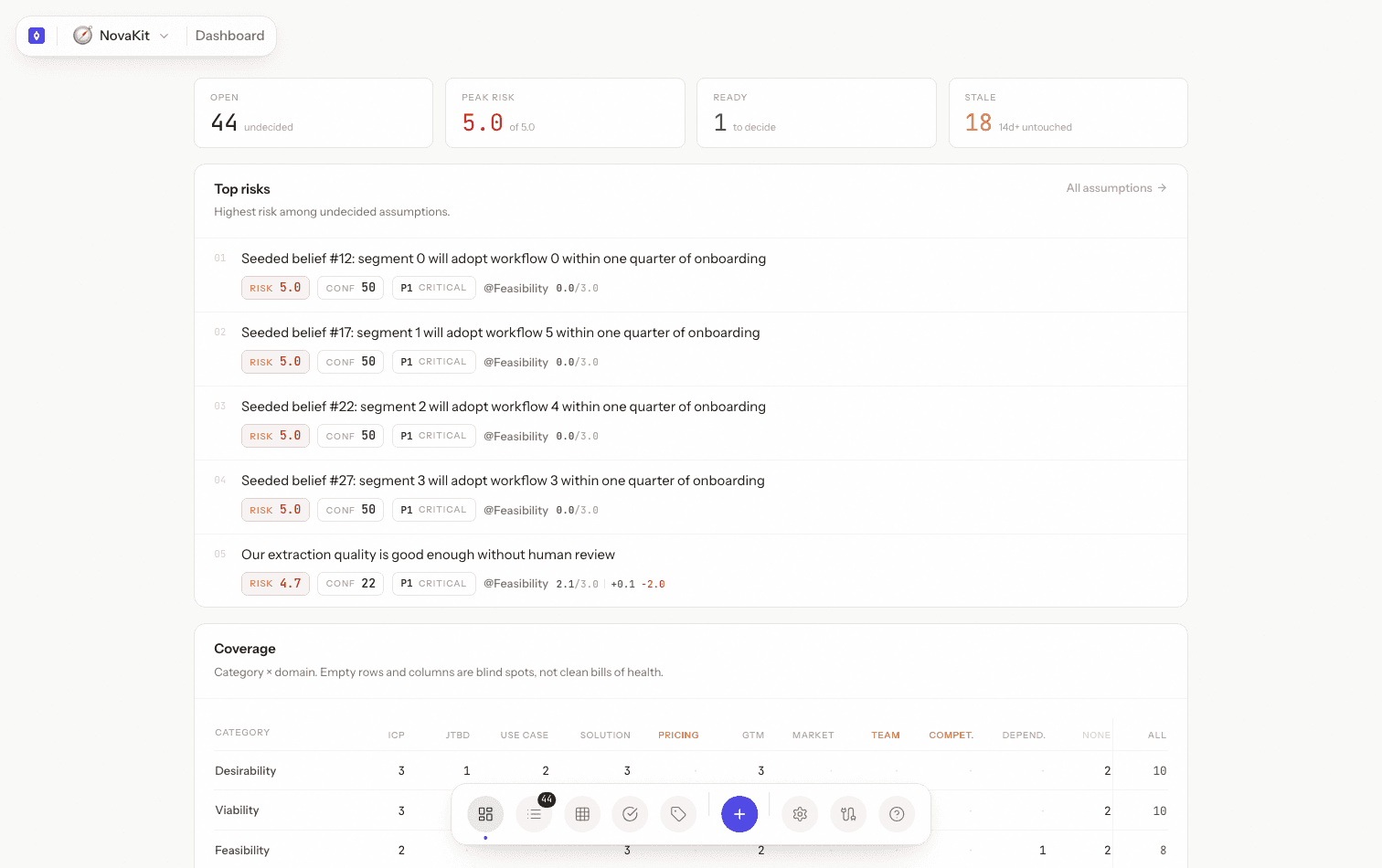
The rule
Fewer, better
Most tools reward you for writing more down. This one pushes back. Restatements of something you already track are merged on ingest, and a source that proposes more than twelve new beliefs is refused outright.
- 10–30
- Live assumptions per project
- The working range. Eighty is a list nobody triages.
- 12
- New beliefs per source, maximum
- Past that the ingest is refused. Trim it or merge it.
- 16
- MCP tools
- For Claude Code, Claude Desktop and Cursor.
How it works
Four moves, run every week
Your agent can drive all of them, or you can work the queue by hand. Same ledger, same scoring.
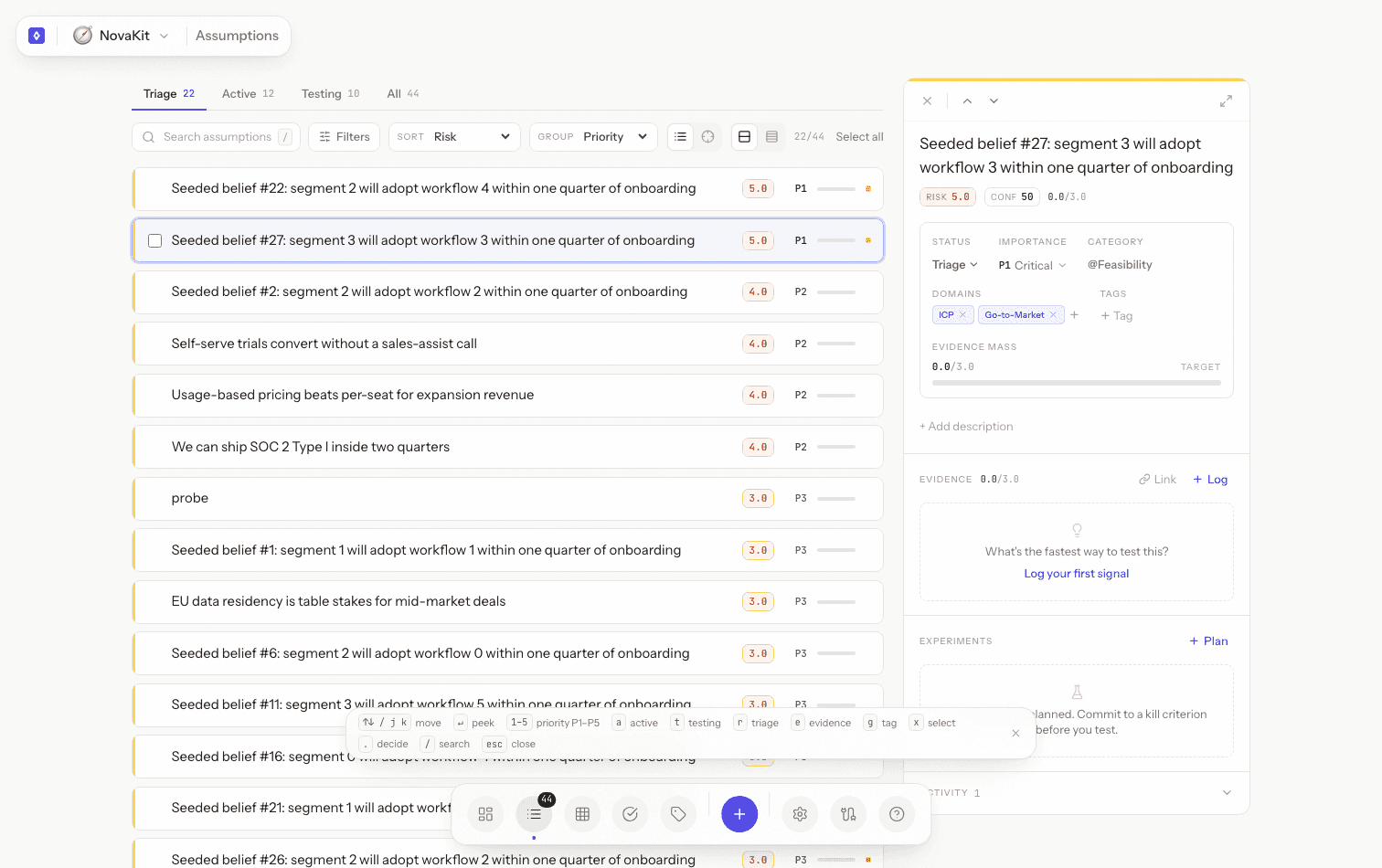
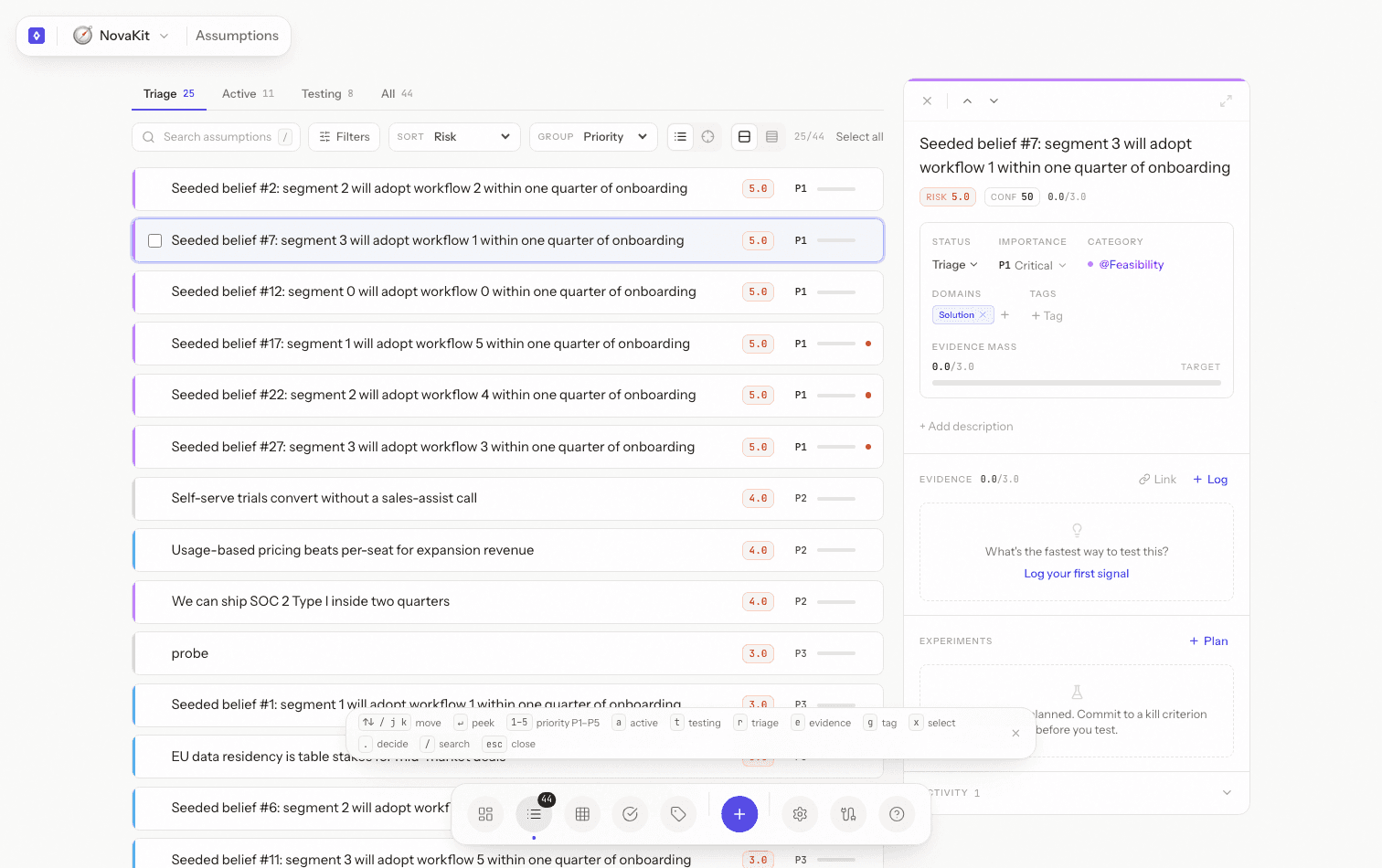
It enters the ledger while it is still a belief
A transcript pasted into the app, a claim typed straight into the queue, or your agent handing over the meeting it just sat through. Each one arrives with a category, a domain and an importance — not as a bullet in a doc nobody reopens.
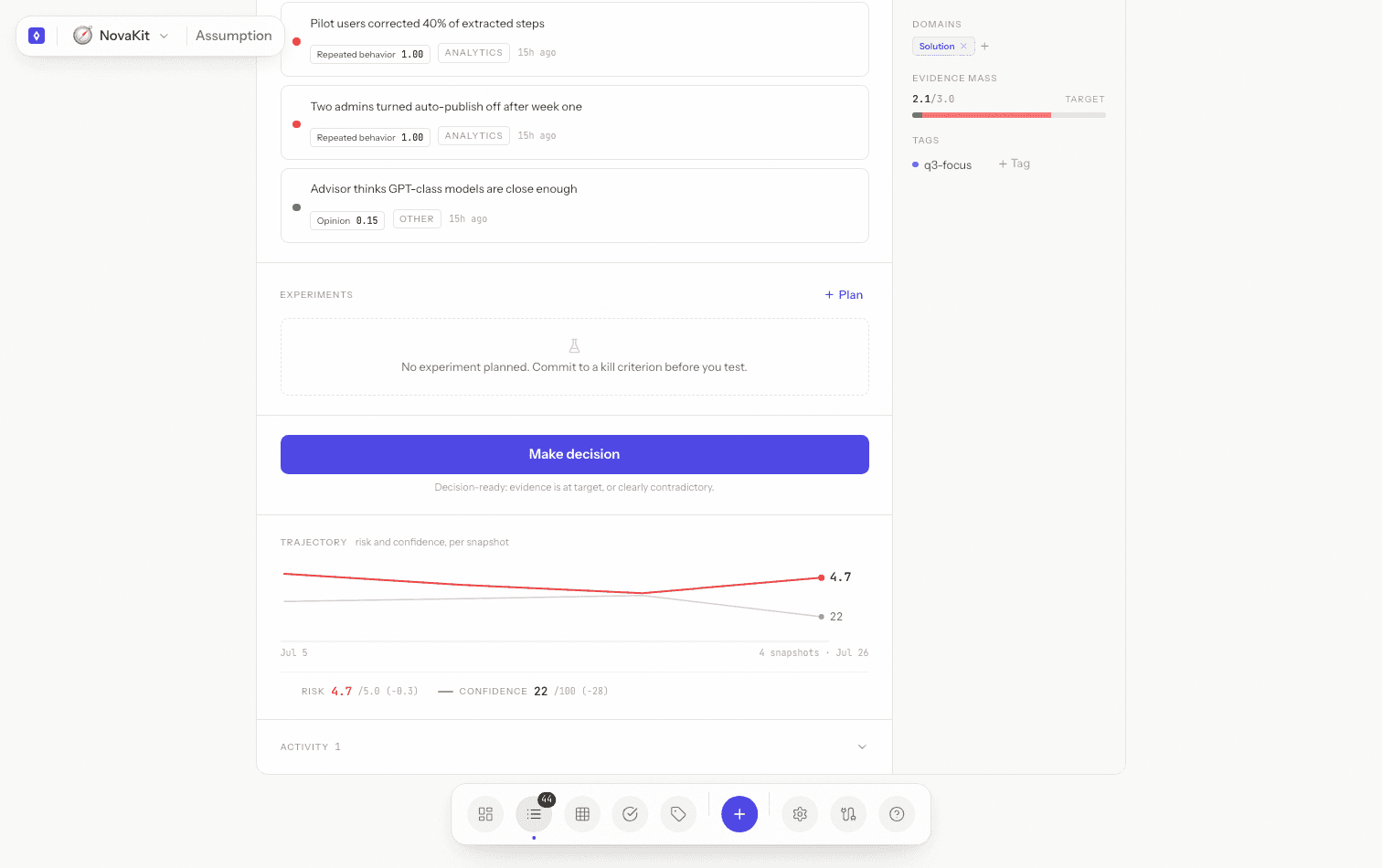
Evidence is graded by what people did, not what they said
Six rungs, from repeated behaviour at the top down to reasoning by analogy at the bottom. Ten enthusiastic quotes are still worth less than one renewal, and the ledger says so out loud.
The week opens with three lists, not a dashboard
What moved since last week. Needs you, overdue tests first. On your plate, the beliefs and tests you personally owe. Everyone gets their own Monday email, and owners get a nudge on Friday.
Record the call, keep the receipts
An assumption is ready once enough real evidence has landed, and a Critical call needs more of it than a Medium one. Decide it and the reasoning stays on record — including for your agent. The one page puts the whole project in front of a board, as a read-only link you can share.
The wedge
One command, and the agent you already have keeps the ledger
A published MCP server with sixteen tools. Add it to Claude Code, Claude Desktop or Cursor, and your agent captures assumptions from a meeting, grades the evidence, plans a test, and reports what moved.
$ claude mcp add assumption-mapper \
    --env ASSUMPTION_MAPPER_API_KEY=am_your_key \
    -- npx -y assumption-mapper-mcp
Create a key in the app under Settings → Account → API keys — read-only, scoped to one project, with an expiry if you want it — then restart the client. Claude Desktop and Cursor take the same server as a four-line JSON block.
Claude Code — assessment brief, excerpt
You
Transcript from this morning’s Delphi call. Log it against NovaKit.
Claude
→ ingest_transcript(projectId: novakit, extraction: 2 assumptions, 2 evidence)
Ingested delphi-2026-07-24.txt · 1 source · 2 evidence items

Assessment:
  Evidence logged: 2 items · 1 independent source
  Strength mix: stated intent ×2
  Assumptions moved (1):
    • confidence 50 → 59 · risk 4.00 → 3.20 · 2 new (2 supports)
      Usage-based pricing beats per-seat for expansion revenue
  Drift flags (1) — stated as settled fact, still undecided:
    • "EU data residency is table stakes for mid-market" —
      named as a requirement, not as a hypothesis.
  Cautions:
    ⚠ All 2 new items are stated intent from a single source —
      one independent data point, not 2.
Both signals are stated intent from one call, so the pricing assumption stays in triage. To test it, give me the kill criterion first — I can’t log an experiment without one.
Works on every plan
Your agent extracts with its own model, so our server makes no AI call and agent-side ingest has no plan gate. Pasting a transcript into the app is the Pro and Team path.
Scores stay server-side
Your agent submits raw evidence: a quote, a direction, a strength, a source. Risk, confidence and evidence mass are computed in Postgres — the write schema has no field for them.
Why it holds up
Two things a doc cannot do for you
A Notion page will hold any belief you put in it, at any confidence you claim, for as long as you like. That is the whole problem.
Evidence that can’t flatter you
Supporting and contradicting evidence are counted separately, and stronger evidence counts for more. Six warm quotes and two hard contradictions do not average out to fine: contradiction raises urgency, so the belief stays loud until you decide.
Evidence strength
Weight
- Repeated behavior1.00
Renewals, recurring usage or purchases.
- Committed behavior0.80
Pre-order, signed LOI, paid pilot, deposit.
- Engagement0.60
Return visits, referrals, unsolicited requests.
- Stated intent0.30
“I would use it / pay for it / switch.”
- Opinion0.15
Expert, advisor or team opinion. Secondhand reports.
- Analogy0.05
Reasoning by analogy, with no external data.
Weight fades with age — half at six months, never below a quarter — so last year’s research stops counting as this year’s proof.
Kill criteria, pre-committed
An experiment cannot be recorded without a written kill criterion: “we abandon this if <observable> by <date>”. It is a required field on the API and an instruction the agent is told not to satisfy on your behalf.
“We already do this in Notion.”
Notion never refuses. It will hold an experiment with no exit condition, and a criterion agreed after you have seen the result is not a criterion.
Where your data sits
- Row-level security on every path
- An API key is exchanged for a short-lived, RLS-scoped token, so it sees exactly what its owner sees — and it cannot mint, list or revoke keys.
- Your transcript can stay with your model
- When your agent extracts, our server makes no AI call. Pasting a transcript into the app is the one path that sends text to Anthropic, our AI subprocessor.
- No ad trackers, no data sale
- Encrypted in transit and at rest, operated from the EU. Delete your account and your data goes within 30 days.
Full detail in the privacy policy.
Pricing
Free today
Paid tiers buy volume and seats, never the method: the ladder, the scoring, kill criteria and the Monday lists are on every plan. Pro and Team are built, but there is no payment integration yet — nothing to buy today.
Free
Available now- 30 active assumptions
- 1 project · 3 members
- MCP server and agent-side ingest
- Monday lists, reports and export
Pro
- Unlimited assumptions
- 20 projects
- AI transcript import in the app
Coming soon
Team
- Everything in Pro
- 20 members
- Shared library and admin
Coming soon
The free cap counts active assumptions, so deciding one frees a slot.
Questions
The ones that actually come up
What counts as evidence?
Why does it refuse to record everything I bring it?
Which agents work with it?
Can my team use it without an agent?
What happens to my transcripts?
Do you train on my data?
Name the beliefs your business is betting on. Then let something other than optimism grade them.
Start with one project and the handful you already argue about.
€0 forever · 30 assumptions · your agent on every plan